
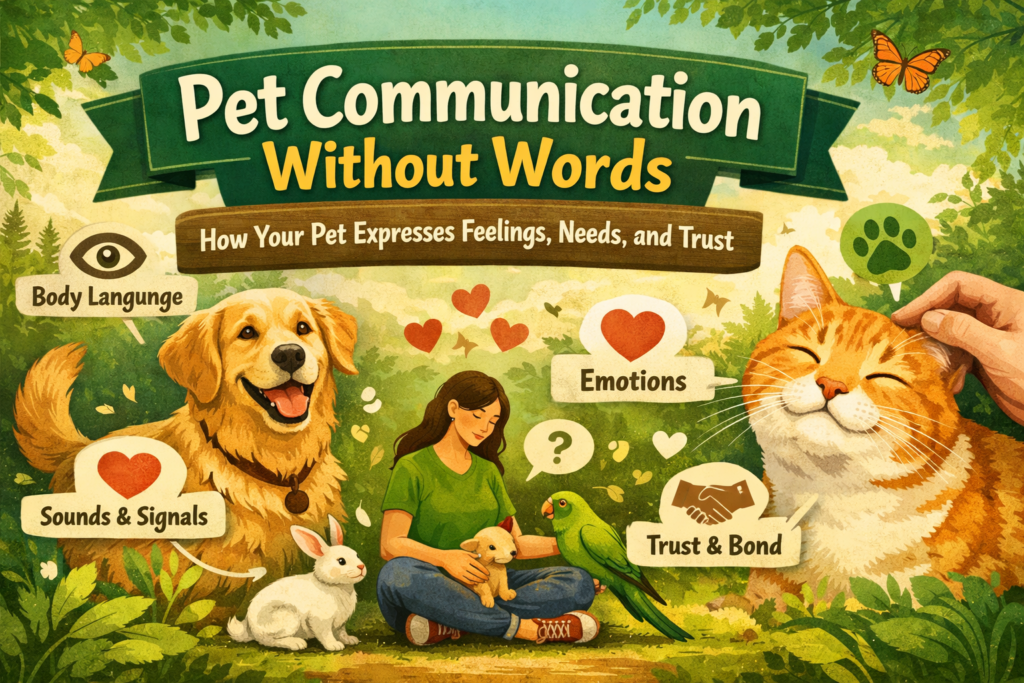
Pet Communication Without Words: How Your Pet Expresses Feelings, Needs, and Trust
Learn how pet communication without words works. Understand pet body language, emotions, and signals to build trust and a stronger bond.
Introduction
Pets may not speak human language, but they are constantly communicating with us. From subtle body movements to eye contact, sounds, and daily behavior patterns, pets use a powerful system of non-verbal signals to express emotions, needs, and trust. Understanding pet communication without words is essential for building a strong emotional bond and ensuring your pet’s mental and physical well-being.
Many pet owners unintentionally ignore these signals, assuming their pet will simply “adjust.” In reality, pets depend on us to recognize and respect their natural communication style. Learning this silent language can transform your relationship with your pet.
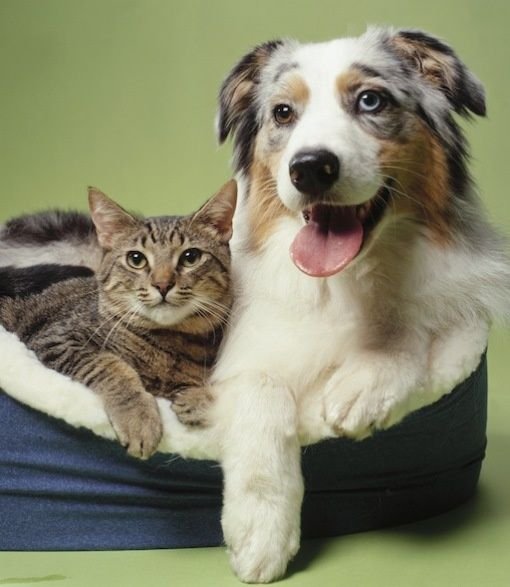
Why Pet Communication Without Words Is So Important
Non-verbal communication is the primary language of animals. Pets use it to:
Express happiness, fear, or stress
Ask for food, play, or attention
Set boundaries
Show trust and affection
When these signals are misunderstood, pets may develop anxiety, behavioral problems, or emotional withdrawal. Understanding pet communication without words helps prevent these issues and creates a calmer, more trusting environment.
Pet Body Language: The Foundation of Communication
Body language is the most visible form of pet communication without words. Every posture and movement has meaning.
Posture and Movement
Relaxed posture indicates comfort and safety
Stiff or frozen body suggests fear or alertness
Lowered body or crouching often shows anxiety
Leaning toward you is a sign of affection and trust
Observing your pet’s body as a whole—not just one movement—helps you understand their emotional state accurately.
Eye Contact and Facial Expressions
Eyes play a major role in pet body language communication.
Soft, relaxed eyes show contentment
Slow blinking (especially in cats) signals trust
Wide eyes can indicate fear or stress
Avoiding eye contact may be a sign of submission or discomfort
In many animals, prolonged staring can feel threatening. Respecting your pet’s comfort level builds trust over time.
What Ears Can Tell You
Ear position is a powerful indicator of mood and awareness.
Forward-facing ears show interest or curiosity
Sideways ears may signal uncertainty
Flattened ears often indicate fear or anxiety
Constant ear movement shows alertness
Understanding ear signals helps decode nonverbal pet communication quickly and effectively.
Animals evolved this form of communication long before humans existed. In the wild, non-verbal signals help animals avoid danger, establish boundaries, show submission, express affection, and maintain social order within their groups. These instinctive behaviors are essential for survival and are still deeply rooted in domestic pets today.
Even though pets now live in human homes, they continue to rely on the same natural signals to communicate. A dog’s tail position, a cat’s slow blink, a bird’s feather movement, or a rabbit’s posture all carry meaningful messages. These signals help pets tell us when they feel safe, stressed, playful, frightened, or in need of attention.
Understanding pet communication without words allows owners to respond more accurately to their pet’s emotional and physical needs. When these signals are recognized and respected, pets feel secure and understood, leading to better behavior, reduced anxiety, and a stronger emotional bond. Ignoring or misinterpreting these cues, however, can result in confusion, stress, and behavioral problems.
Non-verbal communication also plays a crucial role in building mutual trust—something often beautifully illustrated in a Heartwarming Dog Adoption Story, where a rescued dog slowly learns to express comfort, fear, and affection through silent signals as trust develops with their new family.
Eye Contact and Facial Expressions
Dogs communicate with their eyes more than we realize:
Soft eye contact – Trust and affection
Avoiding eye contact – Stress or discomfort
Whale eye (showing whites) – Anxiety or fear
Slow blinking – Calmness and bonding
A relaxed face with a slightly open mouth often means your dog is content.
How Cats Communicate Without Words
Cats are subtle communicators. Their signals are quieter but equally meaningful.
Tail Movements in Cats
A cat’s tail speaks volumes:
Tail straight up – Happy and confident
Slow swishing – Focused or mildly irritated
Fast flicking – Annoyed or overstimulated
Puffed-up tail – Fear or aggression
Unlike dogs, a moving tail in cats often signals irritation rather than happiness.
Body Position and Comfort Levels
Curled up tightly – Security and warmth
Exposed belly – Trust (not always an invitation to touch)
Flattened body – Fear or stress
Arched back – Defensive behavior
Cats express comfort and discomfort clearly through posture.
Silent Communication in Birds
Birds rely heavily on body language and movement.
Feather Position and Meaning
Fluffed feathers – Relaxed or cold
Sleek feathers – Alert or anxious
Ruffled feathers with aggression – Threatened
Birds also communicate through head movements, wing positioning, and eye pinning (rapid pupil changes).
Body Movement and Trust
A bird that leans toward you, preens in your presence, or gently grinds its beak is showing contentment and trust.
Small Pets and Their Non-Verbal Language
Rabbits, hamsters, guinea pigs, and reptiles also communicate silently.
Rabbits
Thumping hind legs – Fear or warning
Binkying (jumping twists) – Happiness
Teeth grinding softly – Contentment
Flattened ears – Stress or fear
Reptiles
Reptiles communicate mainly through posture and movement:
Basking openly – Comfort
Hiding frequently – Stress or illness
Open mouth display – Defensive behavior
Understanding these signs helps owners provide better environments.
Rabbits use their whole bodies to communicate:
Binkying (jumping and twisting in the air) – Extreme happiness and excitement
Thumping hind legs – Fear, warning, or annoyance
Ears upright and forward – Alert and curious
Ears flattened against the back – Stress, fear, or anger
Teeth purring (soft grinding) – Relaxation and contentment
A relaxed rabbit stretched out on the floor shows complete trust and comfort.

The Role of Energy and Emotion in Pet Communication
Pets are extremely sensitive to human emotions. They respond to tone, posture, and energy rather than words.
Calm energy makes pets feel safe
Stress or anger can make pets anxious
Consistent behavior builds trust
This emotional awareness is a key part of pet communication without words.
Signs Your Pet Is Trying to Tell You Something
Your pet may be communicating needs such as:
Hunger or thirst
Pain or discomfort
Fear or stress
Need for attention
Desire to play or rest
Ignoring these signals can lead to behavioral issues or health problems.
How to Improve Communication With Your Pet
Improving silent communication is about observation and respect.
Practical Tips
Watch your pet’s body language daily
Learn their unique behavior patterns
Respond calmly and consistently
Avoid forcing interaction
Reward positive communication
Every pet has its own “dialect” of non-verbal signals.
Common Mistakes Pet Owners Make
Many misunderstandings happen because humans project emotions onto pets.
Assuming wagging always means happy
Forcing cuddles when a pet is uncomfortable
Ignoring stress signals
Punishing natural communication behaviors
Respecting a pet’s boundaries builds long-term trust.
The Emotional Bond Built Through Silent Communication
When you understand pet communication without words, something beautiful happens. Your pet feels seen, heard, and respected—even without language.
This deepens emotional bonding, reduces anxiety, and creates a safe environment where your pet can thrive.
Pets don’t need words to say:
“I trust you”
“I’m scared”
“I’m happy”
“I need help”
They say it with their bodies, eyes, and presence.
Final Thoughts
Pet communication without words is not mysterious—it’s natural. Animals speak through behavior, posture, expression, and energy. When we take the time to listen with our eyes and hearts, we become better companions.
By understanding your pet’s silent language, you strengthen your relationship, improve their emotional well-being, and create a home filled with trust and mutual respect.
Your pet has been talking to you all along—now you know how to listen.
Slow Blinking: The Cat “I Love You”
One of the most beautiful forms of pet communication without words is a cat’s slow blink.
When a cat slowly closes and opens its eyes while looking at you, it’s a sign of trust and affection. You can return the slow blink to strengthen your bond.
One of the most beautiful and meaningful forms of pet communication without words is the slow blink, often called the cat version of saying “I love you.” Cats are naturally cautious animals, and prolonged eye contact in the animal world is usually seen as a threat. When a cat slowly closes and opens its eyes while looking at you, it is a powerful sign of trust, comfort, and affection.
Slow blinking shows that a cat feels safe in your presence. By partially or fully closing their eyes, cats make themselves vulnerable, which they would never do around someone they perceive as dangerous. This gentle gesture indicates emotional bonding and a sense of security.
What Does a Slow Blink Mean?
Trust and safety – Your cat feels secure around you
Affection – A sign of emotional bonding
Relaxation – Your cat is calm and stress-free
Friendly intent – No threat or aggression
This form of non-verbal communication is especially important for shy or reserved cats that may not show affection through physical touch.

(FAQ) – Pet Communication Without Words
1. What is pet communication without words?
Pet communication without words refers to the way animals express their emotions, needs, and intentions through body language, facial expressions, posture, eye contact, and behavior rather than spoken language. Pets rely on non-verbal cues such as tail movements, ear positions, vocal tones, and energy to communicate with humans and other animals. Understanding these signals helps pet owners respond more accurately to their pet’s emotional and physical needs.
2. How do pets communicate their emotions?
Pets communicate emotions like happiness, fear, stress, and trust through physical signals. For example, a relaxed body, soft eyes, and gentle movements usually indicate comfort and happiness, while stiff posture, hiding, flattened ears, or excessive grooming may signal anxiety or fear. Each pet species—and even individual pets—has unique ways of expressing emotions without words.
3. Can pets understand human emotions without words?
Yes, pets are highly sensitive to human emotions. They often respond to tone of voice, body posture, facial expressions, and energy levels rather than actual words. Dogs and cats, in particular, can sense stress, sadness, or happiness and may adjust their behavior accordingly, such as offering comfort or becoming anxious themselves. This emotional sensitivity is a major part of pet communication without words.
4. How can I tell if my pet trusts me?
Trust is shown through relaxed and vulnerable behaviors. Signs of trust may include maintaining soft eye contact, following you around, sleeping near you, exposing their belly, slow blinking (in cats), or calmly accepting handling. A pet that trusts you feels safe in your presence and does not constantly stay on alert or defensive.
5. Why is understanding non-verbal communication important for pet care?
Understanding pet communication without words helps prevent misunderstandings that can lead to stress, fear, or aggression. When owners misinterpret signals—such as assuming a pet wants attention when it actually wants space—it can damage trust. Proper understanding improves training, strengthens emotional bonding, and supports a pet’s mental and physical well-being.
6. Do all pets communicate without words in the same way?
No, communication styles vary greatly between species and even between individual pets. Dogs tend to use more expressive body movements, while cats rely on subtle signals like tail flicks and eye movements. Birds, rabbits, reptiles, and small mammals each have their own non-verbal communication systems. Learning species-specific behavior is essential for accurate understanding.
7. Can pets communicate pain without making sounds?
Yes, pets often hide pain and communicate it silently. Changes in behavior such as reduced activity, hiding, aggression, changes in posture, lack of appetite, or unusual grooming can indicate discomfort or illness. Because pets cannot verbally explain pain, observing non-verbal cues is critical for early detection of health problems.
8. How can I improve communication with my pet?
You can improve communication by observing your pet daily, respecting their boundaries, responding calmly to signals, and learning their individual behavior patterns. Avoid forcing interaction and allow your pet to express itself naturally. Over time, mutual understanding grows, leading to a stronger and more trusting relationship.
9. Is pet communication without words scientifically proven?
Yes, animal behavior studies and veterinary science strongly support the concept of non-verbal communication in pets. Research shows animals rely on visual and behavioral signals for social interaction, survival, and bonding. Many trainers and veterinarians base their methods on understanding these silent communication cues.
Pingback: Heartwarming Dog Adoption Story: Couple Adopts Blind Puppy & Brother | PET NATURE
Having fun with belbet at the moment! Depositing was easy and I had no problem withdrawing. It’s worth checking if you’re looking for good promotions: belbet